Some minor changes to the text are noted at the end of the book.
[Pg 1]
Health is Better than Wealth.

UTILE DULCI
By PROF. NEMO,
Corresponding Editor of “Le Livre,” from Paris.
HUYLER’S CHOCOLATE WORKS,
S. E. Cor. 18TH St. and Irving Place,
NEW YORK.
[2]
Copyright, 1885,
By PROF. NEMO.
Press of J. J. Little & Co.,
Nos. 10 to 20 Astor Place, New York.
[3]
Among the American people there is comparatively but a slight knowledge of the excellent properties of good chocolate, and the many benefits derived from a generous and frequent use of it in its various forms of food and bon-bons.
In presenting a full account of its manufacture, we give a history of the cacao bean, from its growth to its final change into the chocolate, ready for use as a delicacy or as an article of food for family use.
We have also added the decided opinions of many eminent authorities of this country, and especially of those in Europe where chocolate has been much longer and more abundantly used; and we believe that its use here will increase to an enormous extent as soon as the people gain a knowledge of its restorative and health giving qualities.
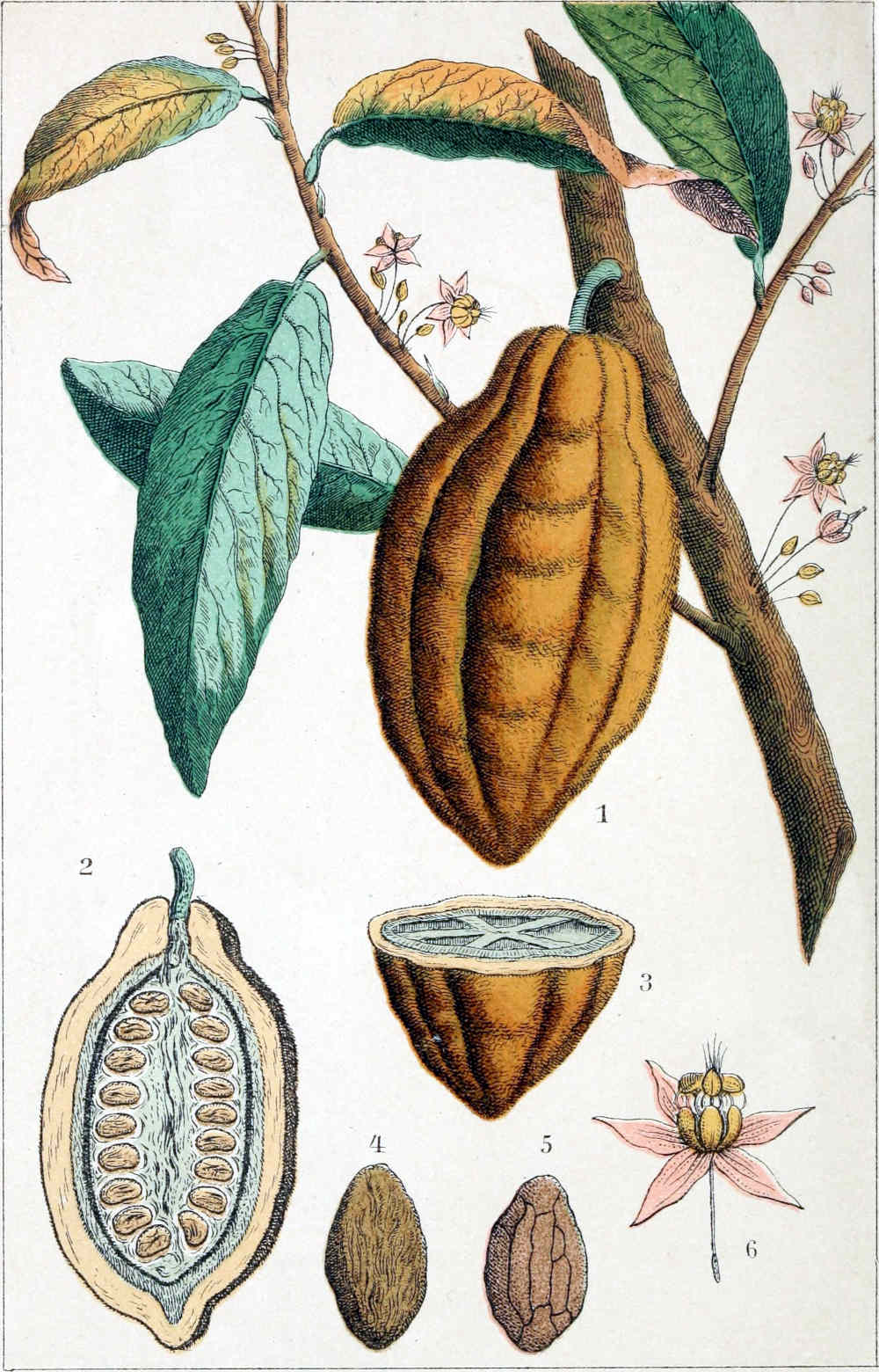
Theobroma cacao, so classed by Linnæus, the celebrated Swedish naturalist, is a beautiful tree found only in the tropical countries.
The Mexican name of the tree is Cocoquahuilt, and the name Theobroma, is derived from two Greek words meaning “food of the gods.”
In the beautiful valleys of Mexico and Venezuela the cacao tree is found in its most perfect beauty and in the highest cultivation. Under that genial climate, vegetation is perennial, and leaves, buds, flowers and fruits are seen together at all seasons, presenting a charming and harmonious array of most picturesque and varied colors—the graceful ornament of the forest of the New World.
The tree is exceedingly delicate; it must have warmth, shade and moisture; the heat should never be less than 70° F.; it must not be transplanted out of its native soil, and, to produce good fruit, it wants a particular quality of land, temperature and atmospheric conditions, which are found united only in the intertropical regions of the American Continent.
The longest period of production of the theobroma cacao tree is from eight to thirty years; it bears usually about a hundred pods (cabosses or mazorcas) [6]of a form and color resembling cucumbers, containing a number of beans enclosed in a rose-colored spongy pulp, which is of itself an article of food.
There are two crops of the pods gathered during the year, in June and December, although the fruit may be collected throughout the whole year, as the pods are continually opening.
The composition of the seed in which amylaceous matter is combined with oil, contains also a principle similar in nature to theïn and caffeïn. As soon as the fruit is collected, the beans are separated from the pulp and dried in the sun. In some countries they are placed in large tubs and covered for several days for the purpose of undergoing a slight fermentation.
The most esteemed of the known kinds of cacao beans are the following: The Soconuzco and Tabasco Cacaos of Mexico; the Caracas Cacaos from Venezuela, among which are the celebrated plantations of Chuao, Maracaibo, Tuy, Porto-Cabello, San-Felipe, and many others.
The second class embraces: Para or Maragnon, and Bahia from Brazil, some from Trinidad, Martinique, Cuba, and other West India Islands, some from Ceylon, Bourbon and Philippine Islands, and some from Florida and Louisiana in the United States.
[7]
Alfred Mitscherlich, a great German chemist, in his notice “Der Cacao und die Chocolade,” published in Berlin in 1859, gives the following analysis. We also reproduce the same from Payen:
| Mitscherlich. | Payen. | |
|---|---|---|
| Fatty matter (fixed oil), | 49 | 50 |
| Albuminoid matter, | 13 | 20 |
| Theobromine, | 3 | 3 |
| Starch, | 14 | 10 |
| Cellulose, | 5 | 2 |
| Mineral substances, | 3 | 4 |
| Coloring matter, | 3 | 0 |
| Ashes, | 3 | 0 |
| Water, | 9 | 11 |
| 100 | 100 |
Theobromine is the active principle of cacao, and its taste and aroma are due mainly to an essential oil and to tannin.
The astringent substance, tannin, is found in a large proportion in the Para cacao, but very seldom in the Soconuzco Caracas, Cauca or Ceylon cacaos; it is for that reason that the mixture of the last named cacaos with the former, is quite indispensable.
From the Dispensatory of the United States of America (Philadelphia: Fifteenth Edition, 1884).
Chocolate is differently prepared in different countries. On the continent of Europe, sugar is generally incorporated with the paste, and spices—especially cinnamon—are often added. Vanilla is a favorite addition in South America, France and Spain. Cacao, called Cocoa, is often sold in powder; in this state it is much employed as a drink at breakfast and tea, and serves as a substitute for coffee in dyspepsia. It is also a good article of diet for convalescents.
From the National Dispensatory (Philadelphia, 1884).
The Cacao is often incorrectly called Cocoa or Chocolate tree; the proper name is Cacao, from the tree Theobroma Cacao.
OIL OF THEOBROMA, BUTTER OF CACAO.
In the manufacture of chocolate a portion of the cacao seed are deprived of their fat by removing the shells, heating the kernels to about 70° C. (158° F.), and pressing them between hot iron plates. The yield from different varieties of cacao is from 35 to 45 per cent.
[10]
The dietetic use of chocolate does not require any detailed notice in this place. Prepared with water or milk, it is employed as a substitute for coffee in southern Europe, South America, Mexico and West India, and to a less degree in other civilized countries. It is to be preferred to the other agents mentioned when a nutritive rather than an excitant operation is desired; and hence it is familiarly employed during convalescence from acute disease, and as a substitute for tea or coffee in the diet of persons whose nervous system is liable to be deranged by them.
The English name cocoa, which is used to designate the product of the highly-prized cocoa bean (Theobroma Cacao), is improperly applied to that fruit; for, according to Webster’s Dictionary (Edition of 1884), cacao is the proper term to use; cocoa should only be employed to designate the fruit or nut of the Cocoa-nut tree.
From A Manual of Practical Hygiene. By Ed. A. Parkes, M.D., F.R.S. (London, 1878).
Although the theobromine of cocoa is now known to be identical with theïn and caffeïn, the quantity of fat is large. It varies even in the same sort of cocoa, but usually from 45 to 50 per cent.
The large quantity of fat and albuminoid substance make it a very nourishing article of diet, and it is therefore useful in weak states of the system (and for healthy men under circumstances of great exertion).
[11]
By roasting, the starch is changed into dextrin, the amount of manganic acid increases, and an empyreumatic aromatic substance is formed.
According to the celebrated French chemist, Payen, the alimentary properties of chocolate are fully proved. The cacao bean contains twice as much azotic matter (nitrogen) as the best flour, about twenty-five times more fatty matter, a notable portion of starch and a very agreeable aroma, whilst the theobromine which it contains produces appetite and facilitates digestion. This analysis of ingredients proves effectually that it is endowed with nutritive power in an eminent degree.
Chevalier, member of the Academy of Medicine and of the Board of Health of Paris, in his treatise on Chocolate, declares that cacao and chocolate are a complete food, and adds that “coffee and tea are not food, but cacao gives one-third of its weight in starch and one-half of its weight in cacao butter, and, converted into chocolate by the addition of sugar, it realizes the idea of a complete aliment, wholesome and eminently hygienic.
“The shells of the cacao bean contain the same principles as the kernels, and the extract, obtained by infusion of the shells in sweetened milk, forms a mixture at once agreeable to the taste and an advantageous substitute for tea and coffee at the breakfast, lunch, dinner and supper table.”
In a recent work by the chemist Boussingault (April, 1883), we read: “Chocolate possesses an essential quality—that [12]of comprising in a small bulk a large portion of nutritive matter.
“In Africa, rice, gum and shea butter help the Arab to cross the desert; in the New World, cacao and chocolate make the heights of the Andes and the vast American forests accessible to man.”
This is at once a perfect food and a most energetic tonic. There is in fact in cacao, legumine, albumine and vegetable meat, associated with fat, starch and sugar, which maintain respiratory combustion; phosphates, the material of the bony system; and lastly, a precious substance, Theobromine.
Huffeland, physician to the King of Prussia, said: “I recommend good chocolate to nervous, excitable persons; also to the weak, debilitated and infirm; to children, to women; I have obtained excellent results from it in many cases of chronic diseases of the digestive organs.”
The celebrated Humboldt, in his narrative of travels, affirms that chocolate possesses an essential quality, viz., that of containing in a small compass a large proportion of the elements necessary to good and healthy feeding.
Fernando Cortez, conqueror of Mexico, probably exaggerated its value when he said: “He who has drunk a cup of Mexican chocolate, can march all day without further nourishment,” but it is quite certain that for long expeditions, as also when hunting, fishing or traveling, especially when it is desirable to reduce the bulk and the weight of the rations, chocolate offers incontestable advantages.
[13]
Baron Liebig, the great chemist and physician, said of chocolate: “It is a perfect food, as wholesome as delicious, a beneficent restorer of exhausted power, but its quality must be good, and its culinary preparation must be careful; chocolate is a substance extremely nourishing and easily digested, it is fitted to repair wasted strength, to preserve health and prolong life. This salutary food agrees with dry temperaments and convalescents; with mothers who nurse their children, and with those whose occupations oblige them to undergo an extensive strain of mind; with public speakers and with all those who give to work a portion of the time needed for sleep. It soothes both stomach and brain, and for this reason, as well as for others, it is the best friend of literary men.”
Voltaire, in his Encyclopædia, calls chocolate “milk for the aged.”
Broussais, a celebrated physician, said: “Chocolate of good quality, well made, and properly cooked, is one of the best aliments that I have yet found for my patients and for myself. This delicious food calms the fever, nourishes adequately the patient and tends to restore him to health. I would even add that I attribute many cures of chronic dyspepsia to the regular use of chocolate.”
Brillat-Savarin, the master of gastronomy, said: “Time and experiment have demonstrated that good chocolate, well-prepared, is an aliment as salutary as it is agreeable; that it is nourishing, of easy digestion and is [14]free from the objections found against coffee; that it is very suitable to persons mentally overworked, to journalists and travelers; it agrees with the most feeble and the most delicate stomachs. A few persons complain of their inability to digest chocolate; good and well-prepared chocolate should agree with any stomach however weak might be its digestive power.”
During the wars of the French Empire the great Napoleon and many of the officers of his staff passed entire days on horseback without other nourishment than a tablet of good chocolate.
[15]
The manufacture of chocolate demands the most scrupulous care in the selection of the different kinds of cacao beans, and the mode of mixing them. A sustained and undivided attention must guide the manufacturer in order to insure continuous perfection in quality.
Upon the arrival of cacaos in the factory all the bags are opened, and their contents spread out in a well-aired apartment, in order to dry the beans and to free them from all humidity previous to the roasting process.
When thoroughly dried they are placed in a hopper of a separator, having six compartments formed of metallic grating, whose meshes being of unequal size mechanically separate the large grains from the smaller, the flat from the round, and thoroughly free them from all particles of dust and foreign substances, so that after this first cleaning and picking the beans are ready for torrefaction (or delicate roasting), in grains of equal size.
The cacao beans are then roasted in a spherical apparatus having a rotary motion, heated by a slow and regular fire, whose temperature does not exceed 130° F.
[16]
In roasting some qualities we use, with excellent results, an imported steam roaster, ours being the only one used in the United States at the present time.
Each kind of cacao bean is roasted in accordance with its natural qualities, the maturity of the fruit, and the size of the kernel.
When the cacao beans are sufficiently cooled they are carried to the hopper of a machine called, in French, Tarare (which is a cracking and fanning machine combined); they fall into the cracker, where they are cracked and separated in different sizes by sieves and boards, which conduct them to the different cases, where they are found perfectly cleaned.
During the operation the wings of the ventilator, revolving with great rapidity, carry off into a special room the shells and dust which have been separated from the grain during the crushing process.
Theory, as well as experience, shows that the proper roasting of cacao is indispensable to the manufacture of good chocolate. Cacao acquires different qualities according to the degree of heat to which it is submitted.
The Italians carry this roasting to excess: their chocolate is more bitter; it dries and irritates the stomach. The Spanish scarcely brown their cacaos; hence the aroma is slightly developed, and their chocolate is more fatty with less flavor, and [17]heavier for digestion. The process used by the French is the best, being between these two extremes, and hence their chocolate is reputed excellent, as gratifying equally the senses of taste and smell. After very careful examination of the various systems of manufacture, the French has been adopted by the house of Huyler’s.
The cacao beans thus roasted, cleaned and separated into broken grains, are then mixed together in the proportions desired, and herein lies the secret of the manufacture. It is next carried to the drying room, and from there to the mélanger where it is subjected, along with sugar, to a first trituration. It then passes on the refiners, which have from three to five polished granite cylinders, where the chocolate is subjected to a crushing sufficiently complete to produce a fineness of quality, and so perfect a union of particles that will present a chocolate paste of the most delicious taste, and which will melt or dissolve in the mouth.
After this long-continued grinding to reduce it to the necessary fineness, the paste is placed in the drying room, heated by steam from 80° to 100° F.
Then the paste having been mixed again in a special mélanger is subjected to pressure in a screw press, in order to drive out the air so as to insure the preservation of the chocolate. It is next weighed out in half and quarter pounds, placed in molds on [18]a table, and submitted to a vigorous shaking, the effect of which is to make the paste take the exact shape of the molds, which reproduce on the tablets the name of Huyler’s. These molds are at once sent down into the spacious cellar, specially constructed for the chocolate.
This cellar is flagged with immense stones, and surrounded with thick flat stone tablets, sealed endwise into the wall, and extending as shelves, on which the warm molds are deposited.
When the chocolate is ready to be taken from the molds it is sent up to the folding room, where the employees first wrap it in pure tinfoil, to keep out moisture and heat (the two great enemies of chocolate); it is then wrapped, sealed, stamped, packed and put aside, waiting to be sent to the salesrooms of the house.
As to the processes of manufacture they are under the supervision of Mr. John S. Huyler, and watched also with attentive and delicate care by a superintendent, whose great experience (here and in France) in every branch of chocolate-making and profound knowledge of cacao beans, assure to those products a uniformity of manufacture, as well as qualities that invariably answer the description in the price-lists, and respond in the most desirable manner to the tastes of the consumers.
[19]
If chocolate has not attained the universal popularity of coffee, it is nevertheless its superior as a food product, at once hygienic and agreeable. The place it should occupy in our regimen gives it an importance, which is daily increasing; in place of poets it has its historians, who are physicians, chemists, and famous gastronomists, and whose eminent opinions, based on positive facts of science, have more weight and authority than the fancies of the imagination or the whims of fashion.
The use of chocolate was introduced into Spain from Mexico at the beginning of the sixteenth century by the companions of Fernando Cortez. Thence it crossed the Pyrenees in 1660, in the train of Maria Theresa, spouse of Louis XIV. It was at first deemed a great luxury to be enjoyed only at the tables of the kings, princes and wealthy financiers of that period; but it gained popularity by degrees, and to-day it has become an almost universal aliment known and praised by every nation of Europe and America.
Chocolate can be used in various forms and generally agrees with all palates. It figures at the feast as well as in the daily routine of domestic life, in sickness as well as in health. It is taken with [20]every repast, at breakfast as well as supper, prepared either with water or milk; at dinner in the form of entremets; at the soiree in ices, bonbons and cakes; between meals, and especially while traveling, it is eaten in the form of tablets, croquettes, sticks, wafers and cigarettes.
In England and the United States powdered cocoas are more extensively used than chocolate in tablets. The best quality of the latter, in which sugar has been incorporated through successive operations, should be preferred and adopted in future for the use of families.
[21]
Great care is necessary in the preparation of good chocolate, which, from the delicate nature of its composition is very susceptible to acquire bad flavor.
In cooking it, it is proper to employ, as far as possible, a chocolatiere, or pan of silver, porcelain, or well plated copper; and for stirring, a hardwood spatula or silver spoon should be invariably used.
DIRECTIONS.
Break into small pieces the number of tablets corresponding to the number of cups needed; put them into the pan and pour over them boiling water in sufficient quantity to entirely cover the broken pieces of chocolate; let the pan stand off the fire without stirring for a few minutes, long enough to soften the chocolate; then gently crush the contents until all is perfectly dissolved; after which place the pan on a slow fire and add the necessary quantity of water and milk. Ten minutes’ boiling will suffice to cook the chocolate; let it then simmer near the fire for about five minutes or more without boiling.
Note.—Each half-pound cake is divided into six tablets, each tablet being the right quantity for one large cup.
[22]
Brillat-Savarin, who was a true connoisseur in gastronomy, has given us a receipt which he obtained from the Superior of the Convent of Belley: When you wish to “take a good cup of chocolate,” he said, “make it overnight in an earthen pot and leave it there, well covered; a night’s repose concentrates it and gives it a velvety softness which renders it perfect. In the morning heat it without boiling. Cold or iced chocolate is also very agreeable.”
Chocolate may be lightened by the addition of water, or made more nourishing by adding milk; but we recommend that it always be dissolved with boiling water, and that, to dissolve it, not less than one-third of the liquid needed for the complete preparation of the beverage be used.
The mode of preparing powdered cacao, or chocolate without sugar, is the same; only the necessary quantity of sugar and flavoring must be added thereto according to taste.
Note.—Chocolates which thicken quickly and become like a sort of paste in cooking are far from the best; they are lumpy, grainy and are often combined with foreign substances. Good chocolate, on the contrary, being composed only of cacao and sugar, should always remain in a creamy state.
[23]
The house of Huyler’s (whose vogue daily increases, thanks to the superior and varied quality of its confections and bonbons) has at length attained the desideratum for its chocolates, which are appreciated and proclaimed the best. To reach this result nothing has been neglected; no sacrifice or outlay in procuring the latest and best machinery has been considered too great, and to-day Huyler’s Chocolate Manufactory is as complete and well-organized as the greatest establishments of the kind in Europe, and produces a thoroughly good chocolate, which is unsurpassed in purity and delicacy of composition, fineness of flavor and general excellence.